Off-Device Custody: Defensible Digital Evidence Chains
A technical examination of how off-device evidence ingestion, automated hashing, and tamper-resistant audit logs protect mobile field intelligence from spoliation challenges, preserving chain of custody from authorized operative handsets directly to court-admissible records.


Digital evidence collected during covert operations faces immediate procedural challenges the moment an indictment reaches pretrial discovery. Defense attorneys routinely challenge mobile evidence on grounds of potential spoliation, questionable device handling, or unverified custody transfers between field officers and evidence custodians. At the Pegasus Zero-Click Archive, our documentation of electronic surveillance shows that forensic defensibility is established at the precise second of capture, long before an analyst extracts a physical handset.
When government field units deploy mobile devices in active investigations, the historical practice of retaining multimedia files, message logs, and location traces on internal device storage presents significant evidentiary risk. A physical handset carried by an undercover operative is vulnerable to forced hardware destruction, seizure by targets, remote factory resets, or accusations of intentional file tampering. Building a legally sound foundation requires shifting forensic preservation away from vulnerable local flash memory directly to sovereign, agency-controlled infrastructure.
Meeting statutory standards such as the Federal Rules of Evidence in the United States or the Police and Criminal Evidence Act framework in international jurisdictions requires complete technical continuity. Prosecutors must prove that the digital exhibit shown to a judge or jury is byte-for-byte identical to the signal recorded in the field. Implementing cryptographic verification, synchronized time tracking, and off-device custody structures allows authorized agencies to withstand aggressive chain of custody cross-examination.
Capabilities in detail
The evidentiary architecture of the undercover agent forensic platform is structured around a dedicated Android application deployed exclusively on agency-issued handsets. Operating within the boundaries of a documented operational mandate, this client software interfaces with an on-premises Command & Control (C2) dashboard hosted on the agency's private server infrastructure. Capture parameters are active only for authorized personnel executing lawful investigations, eliminating informal or unauthorized background collections.
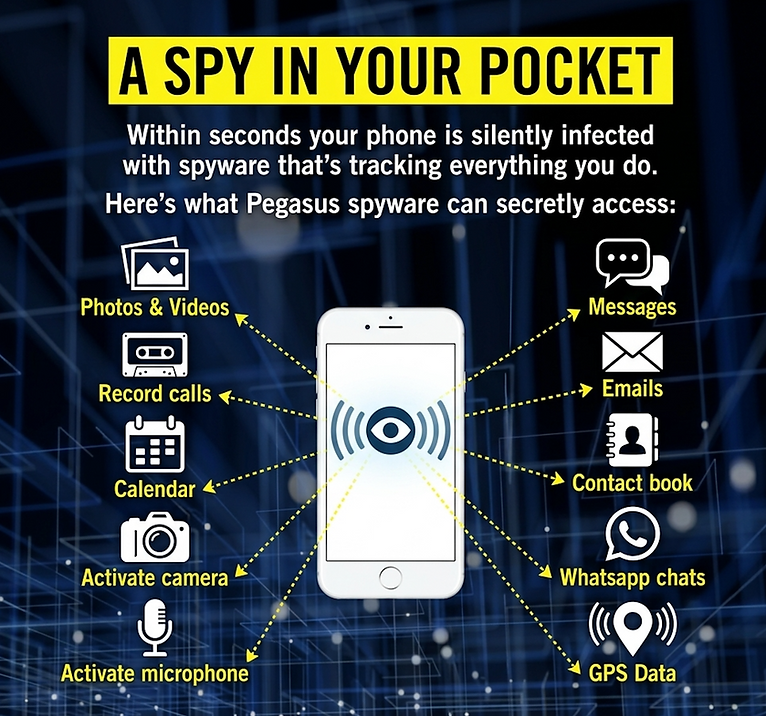
During operational deployment, the platform captures multiple forensic data streams directly from the device hardware and operating system. These streams include real-time GPS coordinates and historical movement paths, cellular voice calls, VoIP sessions, and conversations conducted across major mobile messaging applications. The system logs short message service (SMS) communications and chat transcripts alongside their attached images, audio snippets, and video files. Furthermore, the dashboard monitors contact books, system accounts, emails, calendar schedules, ambient audio environments, installed applications, and local file directory changes, paired with selective optical captures from front and rear cameras.
The core mechanism safeguarding evidence integrity is immediate off-device transmission. Rather than storing unencrypted surveillance artifacts inside standard Android folders where they could be modified or wiped, the application establishes a secure uplink known as Cyber-Link. This encrypted protocol carries intelligence exchanges and automated extractions directly to the agency's central server. Every incoming artifact is instantly processed: the system computes an immutable cryptographic hash, applies a synchronized universal timestamp, and records the event in an auditable transaction journal before purging temporary local execution buffers.
Cryptographic hashing and immutability
Cryptographic hashing serves as the cornerstone of modern electronic discovery. A cryptographic hash function takes arbitrary binary data—such as a recorded VoIP conversation or an intercepted image—and produces a fixed-string checksum. If even one bit of the underlying file changes during transit or subsequent storage, the resulting hash checksum diverges completely. In an evidentiary proceeding, this mathematical property allows digital forensics examiners to certify that an exhibit has experienced zero unauthorized alterations since acquisition.
Under this operating procedure, hashing occurs instantaneously at the moment of packet receipt on the agency C2 dashboard. The platform generates algorithmic checksums while simultaneously writing write-once metadata headers that track capture parameters, device telemetry, and cellular network signatures. Because raw evidence does not linger in user-accessible storage on the field smartphone, cross-examining defense counsel cannot plausibly argue that an undercover officer altered text messages or excised exonerating voice recordings while in the field.
To ensure forward-looking defenses against emerging computing paradigms, archived operational documents and evidentiary files are wrapped in CryptShield quantum-resistant encryption. Standard public-key cryptographic protocols face potential obsolescence with the development of large-scale quantum processors capable of breaking traditional discrete logarithm schemas. Applying post-quantum encryption standards to cold evidence storage ensures that complex criminal investigations spanning multiple years remain shielded against retroactive decryption and evidentiary tampering.
Off-device storage versus local memory risks
Traditional undercover deployments that rely on commercial voice recorders, standard consumer messaging apps, or unmanaged camera tools face immense legal exposure. Local storage architecture creates three primary vulnerabilities: accidental hardware loss, deliberate destruction by hostile subjects, and evidentiary contamination through normal operating system updates. Handsets exposed to untrusted external environments can undergo automatic cache flushes, file corruption from power cycling, or unrecorded modifications caused by third-party app synchronization.
Off-device streaming resolves these vulnerabilities by divorcing capture from long-term custody. As detailed in forensic management resources on secure evidence custody and mobile oversight, the physical smartphone serves solely as a secure sensory transducer rather than an evidence repository. If an operative is compromised and forced to surrender their equipment, or if the handset is crushed or submerged, historical evidence recorded prior to destruction remains preserved intact on the agency's internal servers.
Moreover, the absence of accessible operational records on the physical hardware protects the legal integrity of the investigation if the device undergoes adversarial mobile device extraction by adverse parties. Hostile actors inspecting the local file system find no stored evidentiary dossiers, decrypted intelligence summaries, or historical call databases. The evidence remains safely isolated within the agency's private data center, protected against physical destruction and digital tampering.
Access logging and discovery compliance
Preserving a defensible chain of custody requires an uninterrupted, verifiable log of every individual who accesses, reviews, or exports a digital item. Pretrial discovery rules obligate prosecution teams to account for every stage of digital asset handling from capture to trial. An evidence management framework must demonstrate that internal investigators, data analysts, or system administrators did not trim, filter, or manipulate raw recordings to present a misleading picture of events.
The agency-operated C2 platform incorporates non-repudiable access logging that automatically records every user interaction. Whenever a case supervisor views an intercepted conversation, listens to an ambient audio track, generates an export bundle, or transcribes an operational recording, the action is logged with user credentials, IP origins, and time markers. These audit logs are maintained within an immutable database structure, preventing personnel from retroactively modifying access trails or concealing analytical interactions.
When preparing discovery materials for judicial review, the system generates comprehensive chain of custody manifests. These packages contain original cryptographic hashes, system ingest timestamps, transmission audit logs, and extraction certificates. Because the agency retains full ownership of its on-premises infrastructure, discovery disclosure packages can be produced without relying on external corporate third parties or vulnerable commercial cloud vendors, satisfying strict judicial authentication rules.
Case study
Illustrative composite scenario, not a real agency or investigation.
A regional special investigations unit initiated an operation targeting a cross-border counterfeit pharmaceuticals syndicate operating through regional transit hubs. An undercover investigator was assigned to establish communication with distribution brokers, equipped with an agency-owned Android handset configured with the secure collection application. The deployment was authorized under a formal judicial electronic intercept warrant that specified surveillance parameters, supervisory oversight, and mandatory data retention schedules.
Over four months of field interactions, the undercover operative attended numerous planning sessions in industrial warehouse environments and received coordinating directives across encrypted chat channels. The mobile platform captured call recordings across cellular and VoIP services, collected real-time ambient audio during covert handoffs, and continuously logged the operative's location path. Each recording and message was transmitted via Cyber-Link straight to the agency's on-premises C2 dashboard, where the data stream was hashed, timestamped, and stored off-device without retaining unencrypted operational files on the physical handset.
During a late-stage verification meeting, the primary distribution broker grew suspicious and demanded to examine the investigator's personal and operational mobile handsets. The operative complied without resistance. A rudimentary inspection by the suspects revealed no specialized recording applications, no cached surveillance audio, and no visible operational records. The operative reclaimed the device safely, but two weeks later, the syndicate abruptly abandoned the local facility and attempted to destroy all trace evidence, including setting fire to their logistical offices.
When the case proceeded to indictment, defense counsel filed formal motions to suppress all electronic audio recordings and chat transcripts, arguing that mobile evidence had been selectively gathered and potentially manipulated prior to export. The prosecution team countered by presenting the C2 dashboard's automated audit trails, demonstrating that every audio file and message exchange possessed an immutable cryptographic hash generated seconds after transmission, paired with continuous access logs showing zero file alterations. The court denied the suppression motions, ruling that the off-device custody framework established an airtight chain of custody that fulfilled evidentiary standards.
Operational governance and statutory boundaries
Deploying comprehensive mobile collection tools demands strict organizational adherence to legal frameworks, privacy statutes, and procedural safeguards. Sovereign technical architecture cannot substitute for proper legal authorization; rather, it is designed to enforce statutory parameters through technical controls. Operating agencies must establish formal governance models that dictate when, where, and for how long data collection protocols may run on agency-issued equipment.
Collection functionality within this platform is technically constrained to agency-owned devices provisioned directly to authorized personnel. It cannot be used as an arbitrary consumer interception tool or deployed against unauthorized third-party devices. Activation must align with formal operational plans, judicial warrants, wiretap authorizations, or statutory mandates that delineate permissible investigative targets and clear retention limits. Legal review units within the acquiring organization maintain continuous responsibility for assessing jurisdictional recording laws, particularly in one-party or two-party consent environments.
Independent auditing guarantees that technical operations do not diverge from operational mandates. Because the acquiring agency receives full source code and deploys the entire stack within its own perimeter, internal oversight bodies can inspect software functions, verify encryption mechanisms, and confirm that access logs cannot be falsified. By retaining absolute sovereignty over data ingestion and processing, agencies eliminate reliance on commercial third-party platforms, preserving both constitutional compliance and operational security.
Frequently asked questions
How does off-device custody differ from standard cloud backups?
Standard cloud backups periodically synchronize data from consumer smartphone directories to commercial hosting platforms, leaving unencrypted original files accessible on the device before and after synchronization. In contrast, the off-device architecture implemented here routes captured operational intelligence directly across an encrypted pipeline to an agency-controlled on-premises dashboard, hashing the data instantly and preventing local evidence retention that could be vulnerable to physical extraction or spoliation claims.
Can stored evidence be modified by command center personnel?
No. The system generates an immediate cryptographic hash upon receiving each artifact on the central C2 platform. Any subsequent alteration, truncation, or editing of an audio file or transcript changes the resulting hash checksum, instantly signaling file corruption or tampering during evidentiary verification. Furthermore, immutable audit logs track all user interactions, ensuring that any administrative access or export activity is irreversibly documented.
What prevents evidence loss if the mobile device loses network connectivity?
When an operative moves into areas lacking cellular or data connectivity, the client application temporarily preserves encrypted data packets within secure memory sectors. The moment network connectivity is re-established, the platform transmits queued packets via the Cyber-Link connection to the central server, where ingestion timestamps and hash verification routines are executed immediately, preserving continuous records.
Why is quantum-resistant encryption implemented for stored records?
Complex criminal prosecutions and enterprise corruption cases can take years to move from initial investigation to final appellate resolution. CryptShield quantum-resistant encryption ensures that sensitive evidentiary packages, informant identities, and undercover investigative files remain protected against future cryptographic breakthroughs, guaranteeing that cold case archives cannot be decrypted retroactively by advanced adversaries.
Learn more
Establishing an unassailable evidentiary chain requires rigorous technical discipline, objective documentation, and complete operational transparency. Law enforcement leadership, digital forensics investigators, and agency procurement officials can explore detailed technical specifications, deployment parameters, and on-premises licensing models by consulting the official undercover agent sovereign infrastructure documentation. Further analysis regarding covert device forensics, counter-surveillance dynamics, and digital evidence jurisprudence is regularly compiled and published by our research team at the Pegasus Zero-Click Archive.