Why End-to-End Encryption Doesn't Stop Pegasus: The Endpoint Problem
End-to-end encryption protects data in transit, but Pegasus reads it after decryption on the device. This analysis explains the endpoint compromise problem and why E2EE alone cannot stop a resident implant.

A common misconception about Pegasus spyware is that using end-to-end encrypted messaging apps like Signal or WhatsApp protects you from it. It does not. This is not a flaw in the encryption — the encryption works as designed. The problem is that Pegasus operates at a different layer than the encryption. Understanding this distinction is fundamental to understanding the spyware threat.
How End-to-End Encryption Works
End-to-end encryption (E2EE) protects data in transit. When you send a message through Signal or WhatsApp, the message is encrypted on your device using a key that only you and the recipient possess. The message travels through the messaging provider's servers in encrypted form. The provider (Signal, WhatsApp/Meta) cannot read the content because they do not have the decryption key. When the message arrives at the recipient's device, it is decrypted and displayed.
The security property of E2EE is: the data is protected while in transit between endpoints. No party in the middle — not the messaging provider, not the internet service provider, not a government conducting network interception — can read the content.
This is a real and important security property. E2EE prevents mass surveillance of communications content through network-level interception. It is why authoritarian governments have sought to ban or break E2EE — it genuinely impedes their ability to monitor communications at the network level.
How Pegasus Bypasses E2EE
Pegasus does not attack the encryption. It attacks the endpoint.
When a message arrives at the recipient's device and is decrypted, the plaintext content exists in the device's memory. It is displayed on the screen, stored in the app's database, and processed by the operating system. At this point, the content is no longer protected by E2EE — it is plaintext on the device.
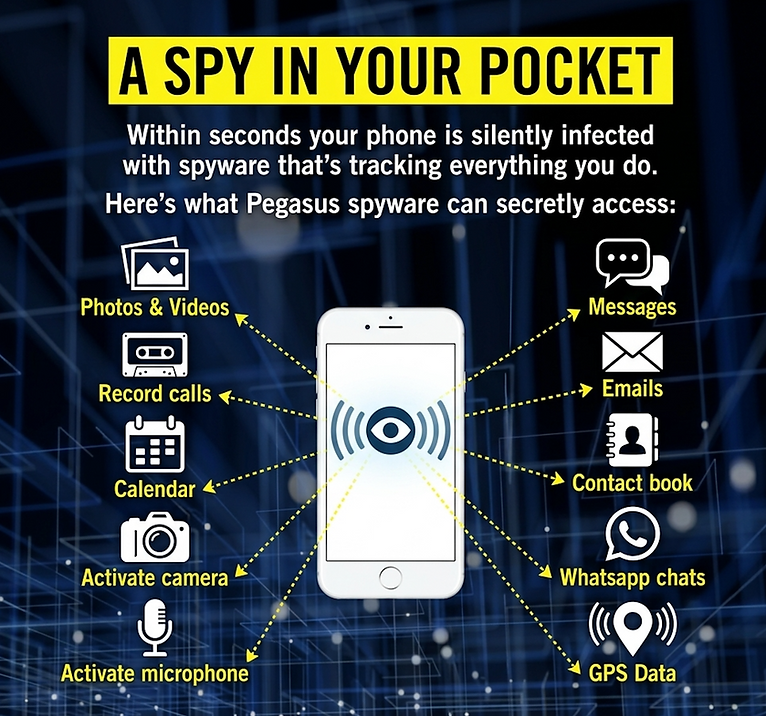
A device-level implant like Pegasus operates after decryption. It reads the plaintext content directly from the device's memory or storage. It can:
- Read messages from the app's local database after they have been decrypted and stored.
- Capture screen content — what the user sees, including decrypted messages.
- Record audio from microphone and capture camera output.
- Access files that the app has stored, including photos and documents received through the encrypted channel.
- Log keystrokes — capturing messages before they are encrypted and sent.
The implant sees what the user sees. It operates at the same level of access as the operating system and the apps themselves. E2EE protects the data while it travels between devices; it does not protect the data once it is decrypted on the device.
The Endpoint Compromise Problem
This is the endpoint compromise problem, and it is not specific to Pegasus. Any malware that achieves operating-system-level access to a device can read data after it is decrypted, regardless of the encryption used in transit. The encryption protects the communication channel; it does not protect the endpoint.
The analogy is physical security: E2EE is like an armored truck that transports documents between two buildings. The documents are protected while in transit. But once the documents arrive at the building and are opened, they are plaintext in the building. If someone has compromised the building — has access to the room where the documents are opened — they can read them. The armored truck does not protect against someone who is already inside the building.
Pegasus is the intruder who is already inside the building. The encryption (the armored truck) is irrelevant because the compromise is at the endpoint (the building), not in transit.
Why This Matters for Defense
Understanding the endpoint compromise problem changes the defense strategy:
E2EE is necessary but not sufficient. You should still use E2EE apps (Signal, WhatsApp) because they protect against network-level surveillance — which is a real and common threat. But you should not assume that using Signal means you are protected from Pegasus. The encryption and the endpoint security are different problems.
Endpoint security is the critical control. If the threat model includes mercenary spyware, the priority is preventing the device from being compromised in the first place. This means:
- Rapid patching — every named Pegasus chain has been patched. The patch interval is the vulnerability window.
- Lockdown Mode (for iOS) — reduces the attack surface, though it is not a guarantee (BLASTPASS demonstrated this).
- Minimal attack surface — disable features you do not use (HomeKit, Find My, unnecessary iMessage integrations).
- Forensic monitoring — for high-risk users, periodic forensic checks using MVT or professional analysis.
The device is the battleground. If the device is compromised, no amount of communication encryption will protect the content. If the device is not compromised, E2EE protects the communication channel. Both are needed; neither alone is sufficient.
The Implications for Policy
The endpoint compromise problem has policy implications that are often misunderstood:
Breaking E2EE would not stop Pegasus. Proposals to weaken or break end-to-end encryption — often framed as combating spyware or protecting children — would not address the Pegasus threat. Pegasus does not exploit E2EE; it exploits device vulnerabilities. Weakening E2EE would reduce protection against network-level surveillance while doing nothing about endpoint compromise. It would make users less secure, not more.
The regulatory focus should be on the spyware vendors, not the encryption. The WhatsApp v. NSO judgment, the Entity List addition, and the UK Supreme Court ruling target the spyware vendor and the state actors who deploy it. These are the appropriate regulatory targets. Weakening encryption would not constrain NSO Group or its customers; it would reduce the security of everyone who uses encrypted communications.
Sources
This analysis draws on: the technical record of Pegasus capabilities documented by Citizen Lab and Amnesty International; Apple's security architecture documentation; the WhatsApp v. NSO case filings; and the established principles of endpoint security. The endpoint compromise problem is a fundamental concept in security engineering — it is not specific to Pegasus, but Pegasus is the most prominent current example of an endpoint-compromising tool.