WhatsApp v NSO: The $4.4M Judgment and What It Means for Spyware Accountability
WhatsApp v NSO Group reached final judgment in 2025 with a $4.4 million award and a permanent injunction. This analysis examines the legal trajectory, the remittitur, and what the injunction actually accomplishes.

WhatsApp v. NSO Group is the most consequential civil litigation against a mercenary spyware vendor to date. Filed in October 2019 in the Northern District of California (case 4:19-cv-07123), the case reached final judgment in November 2025 with a $4,447,190 award and a permanent injunction barring NSO from targeting WhatsApp users.
This post analyzes the legal trajectory, the remittitur of punitive damages, and what the injunction actually accomplishes — and does not — for spyware accountability. It is written for legal observers, policy professionals, and researchers tracking the accountability landscape.
The Case: Background and Claims
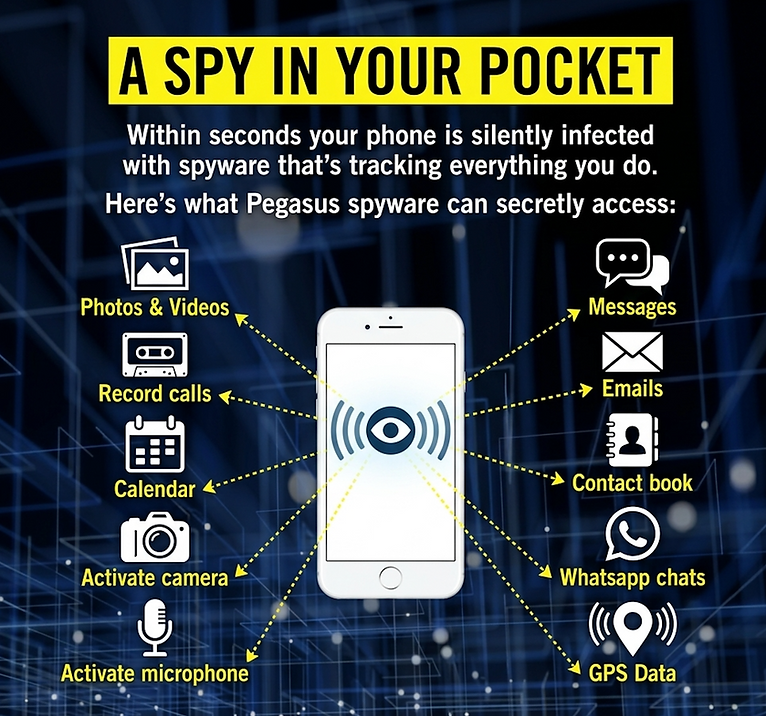
WhatsApp (Meta) sued NSO Group after identifying approximately 1,400 users targeted by a Pegasus zero-click exploit delivered through WhatsApp's calling feature in April and May 2019. The exploit, designated CVE-2019-3568, exploited a vulnerability in WhatsApp's call setup process — the phone was compromised when the WhatsApp call was processed, before the user answered (or even if they never answered).
The legal claims were grounded in:
- The Computer Fraud and Abuse Act (CFAA) — the primary US federal computer-crime statute, which provides a civil cause of action for unauthorized access to protected computers.
- California computer-access law — state-level provisions covering unauthorized access to computer systems.
- Breach of contract — WhatsApp's terms of service prohibited the kind of automated access and exploitation that Pegasus required.
The case was significant from the outset because it targeted not the government customer who operated Pegasus but the vendor that built and licensed it. This is a different accountability theory than suing a state for surveillance — it holds the commercial supplier responsible for how its product is used.
The Jurisdiction Fight and the Ninth Circuit
A central legal question was whether NSO Group, an Israeli company, was subject to the jurisdiction of US courts for Pegasus operations that targeted WhatsApp users. The case reached the Ninth Circuit, which in 2025 revived claims that had been dismissed, finding that NSO's conduct was sufficiently connected to the United States (through WhatsApp's US-based infrastructure and the targeting of WhatsApp users) to support jurisdiction.
The jurisdiction question matters beyond this case because it determines whether US courts are available as a forum for holding foreign spyware vendors accountable. The Ninth Circuit's revival established that the connection to US-based platforms can be sufficient — a precedent relevant to future litigation against other mercenary spyware vendors.
Summary Judgment on Liability: December 2024
On 20 December 2024, the court granted summary judgment on liability to WhatsApp. This meant the court found NSO liable as a matter of law on the CFAA, California computer-access law, and breach of contract claims, without requiring a jury trial on the question of liability itself.
Summary judgment is significant because it establishes the legal principle: a spyware vendor can be held liable under the CFAA for building and licensing a tool that is used to access a computer system (WhatsApp's servers and client software) without authorization. This is not a finding about a specific incident — it is a structural legal conclusion about the vendor's responsibility for how its product is used.
The Jury Verdict: May 2025
A jury trial on damages was held in May 2025. The jury returned a verdict of:
- $444,719 in compensatory damages — representing the actual harm to WhatsApp from the targeting campaign.
- $167,254,000 in punitive damages — intended to punish NSO and deter future conduct.
The punitive damages figure was striking — roughly 376 times the compensatory award. Punitive damages of this magnitude are rare and signal that the jury found NSO's conduct sufficiently egregious to warrant a substantial penalty.
The Remittitur: October 2025
On 17 October 2025, Judge Phyllis Hamilton remitted (reduced) the punitive damages. The reduction is important to understand.
Under California law and constitutional due process principles (following the US Supreme Court's framework in cases like State Farm v. Campbell), punitive damages must bear a reasonable relationship to compensatory damages. While there is no fixed ratio, punitive awards that are overwhelmingly disproportionate to compensatory damages can be struck down as constitutionally excessive.
The court reduced the punitive damages from $167,254,000 to $4,002,471, resulting in a total judgment of $4,447,190 ($444,719 compensatory + $4,002,471 punitive). The ratio of punitive to compensatory damages after remittitur is approximately 9:1, which is within the range that courts have generally considered constitutionally permissible.
Plaintiffs accepted the remittitur on 31 October 2025. This is a strategic choice — accepting the reduced amount avoids the risk of a new trial on damages, which could result in a lower award or a different outcome. The acceptance finalized the judgment.
The Permanent Injunction: November 2025
On 12 November 2025, a permanent injunction was entered barring NSO Group from targeting WhatsApp or WhatsApp users. This is the structural remedy and, arguably, the most consequential part of the judgment.
An injunction is different from a damages award in a critical way: a damages award is a one-time financial penalty, but an injunction is an ongoing legal prohibition. Violation of an injunction can result in contempt proceedings, which can include ongoing financial penalties and, potentially, other consequences.
The injunction's value is that it creates a legal constraint that persists regardless of NSO's financial situation or ownership changes. Even if the $4.4 million judgment is manageable for NSO (and the remittitur made it more manageable than the original $167 million punitive award), the injunction creates ongoing legal exposure if NSO targets WhatsApp users again.
The Contempt Question: June 2026
Reporting in June 2026 indicated that Meta asked the court to hold NSO in contempt over alleged further WhatsApp activity. This is a significant development if substantiated, because it would test whether the injunction has teeth — whether a court will enforce it against continued conduct.
However, researchers should treat the contempt outcome as unconfirmed unless a subsequent court order is published. Allegations of contempt are not the same as a finding of contempt. The court must evaluate the evidence and issue an order. As of this writing, no contempt finding has been publicly confirmed.
If contempt is found, it would establish that civil injunctions can be enforced against mercenary spyware vendors for post-injunction conduct — a meaningful precedent for accountability. If contempt is not found, it would suggest the limitations of civil injunctions as a constraint on spyware operations.
What the Judgment Accomplishes — and Does Not
The WhatsApp v. NSO judgment accomplishes several things:
- It establishes legal liability for a spyware vendor under the CFAA for building and licensing a tool used to access a platform without authorization. This is a precedent that can be cited in future cases.
- It creates a permanent injunction that legally prohibits NSO from targeting WhatsApp users. This is an ongoing constraint, not a one-time penalty.
- It produces a financial penalty of $4.4 million. The remittitur reduced this from the jury's original award, but it is still a tangible cost.
What the judgment does not accomplish:
- It does not identify or constrain the government customers who operated Pegasus. The case was against the vendor, not the operators. The approximately 1,400 targeted users were victims of the operation, but the government customers who directed the targeting are not parties to this case.
- It does not prevent NSO from targeting non-WhatsApp platforms. The injunction is specific to WhatsApp. Pegasus can still be delivered through iMessage, SMS, and other vectors.
- It does not prevent other spyware vendors from similar conduct. The judgment is specific to NSO. Cytrox (Predator), Paragon (Graphite), and other vendors are not bound by this injunction.
- The financial penalty, post-remittitur, may not be sufficient to deter a company with substantial revenue from government contracts. The original $167 million punitive award would have been a meaningful deterrent; the $4 million post-remittitur amount is less clearly so.
The Broader Accountability Landscape
The WhatsApp judgment exists alongside other accountability mechanisms:
- The US Commerce Entity List (3 November 2021) — NSO was added, restricting its access to US items. This is an export control measure, not a legal judgment, but it has practical consequences for NSO's operations.
- The Dada v. NSO case (El Faro journalists) — dismissed 30 September 2026 for lack of personal jurisdiction. This dismissal is procedural, not a finding that the infections did not happen. It demonstrates that jurisdiction remains a barrier in some cases.
- The UK Supreme Court ruling (27 July 2026) — established that foreign states are not immune from UK civil claims over spyware used against people in the UK. This is a jurisdiction precedent relevant to future cases.
- The PEGA committee — the European Parliament's spyware inquiry, which recommended tighter rules but did not produce binding law.
The WhatsApp judgment is the most concrete civil accountability outcome to date. But the landscape of accountability mechanisms — civil litigation, export controls, criminal complaints, parliamentary inquiries — is still developing. No single mechanism has proven sufficient on its own.
Sources
This analysis draws on: court filings and orders in WhatsApp v. NSO Group, N.D. Cal. 4:19-cv-07123; the Ninth Circuit's 2025 ruling; reporting on the contempt allegations (June 2026); the Dada v. NSO dismissal (30 September 2026); the UK Supreme Court ruling (27 July 2026); and the Commerce Department's Entity List addition (3 November 2021). Legal analysis is based on the public record; this post does not constitute legal advice.