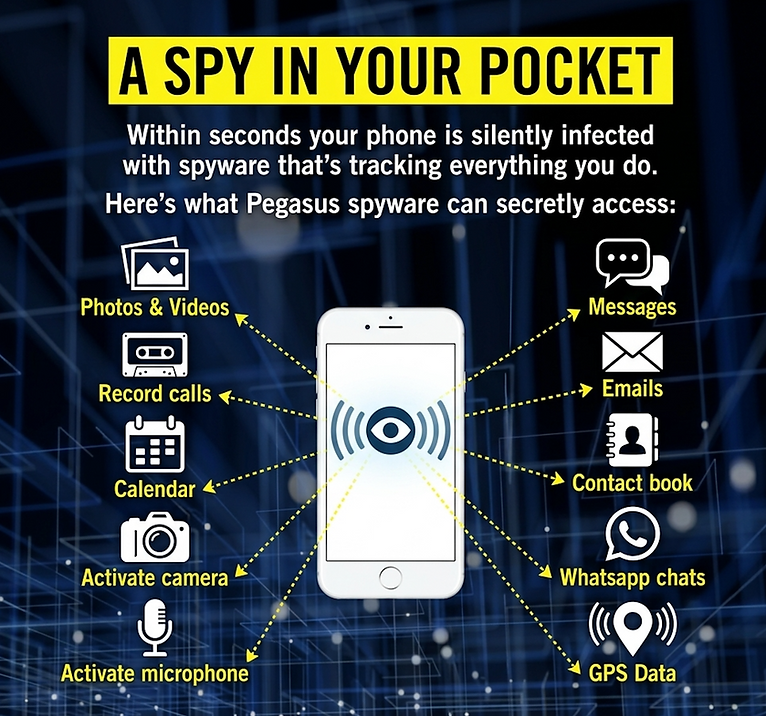
Pegasus Spyware in 2026: The Current Zero-Click Threat Landscape
The Pegasus spyware threat landscape shifted materially in late 2025 and 2026. A confirmed iMessage zero-click in Serbia, a final judgment against NSO Group, and new forensic reconstructions have reshaped what we know about mercenary spyware operations.

If you are tracking mercenary spyware, 2026 is the year the public record caught up with the operational reality. For nearly a decade, Pegasus spyware operated by NSO Group was documented primarily through retrospective forensic analysis — a phone gets infected, months later a lab finds the artifacts. What changed in late 2025 and through 2026 is the density of confirmed cases, the granularity of the forensic record, and the legal consequences finally reaching the company that built the tool.
This post synthesizes the current state of the Pegasus spyware threat landscape as of October 2026, drawing on primary sources from Citizen Lab, Amnesty International Security Lab, Google Project Zero, court filings in WhatsApp v. NSO, and Apple security advisories. It is written for defenders, journalists, and policy professionals who need an evidence-grounded picture rather than a headline summary.
The Serbia iMessage Zero-Click: A New Infection Window
The most significant technical development is the confirmation of a Pegasus zero-click infection in Serbia, published by Citizen Lab and the SHARE Foundation on 2 September 2026. The investigation documented an iMessage-based zero-click exploit with a high-confidence infection window of December 2025 through January 2026, targeting an iPhone associated with Serbia's student protest movement.
Several things make this case notable for threat researchers:
- It is the first forensically confirmed Pegasus infection in Serbia. Prior reporting on Serbian digital threats centered on Cytrox Predator, a different mercenary spyware product. The Citizen Lab report establishes that Pegasus was also in use.
- The exploit was patched in iOS 18.4.1. This gives us a patch timeline that defenders can map against their own fleet. If you have devices that were not updated past iOS 18.4.1 during that window, they were potentially vulnerable.
- At least 14 Apple threat notifications were issued to individuals in Serbia's protest movement, civil society, and an opposition MP. Apple's threat notification program alerts users it believes were targeted by state-sponsored attackers. A notification indicates targeting was detected — it is not necessarily proof of successful infection, but the density of notifications in a single national context is significant.
The Serbian government's response followed a familiar pattern. The BIA (Security Information Agency) dismissed the findings, and President Aleksandar Vučić characterized them as "suspicions." On 6 October 2026, Balkan Insight reported that lawyers for Serbian activist Jelena Kontić filed a criminal complaint stemming from the confirmed infection. The legal trajectory is worth monitoring because criminal complaints in spyware cases are rare — most accountability has proceeded through civil litigation and export controls.
The WhatsApp v. NSO Final Judgment
On the legal front, the WhatsApp v. NSO case reached final judgment in 2025. For researchers who have followed this litigation since it was filed in October 2019, the trajectory is instructive.
The court granted summary judgment on liability to WhatsApp on 20 December 2024, finding NSO Group liable under the Computer Fraud and Abuse Act, California computer-access law, and breach of contract. A jury trial in May 2025 returned a verdict of $444,719 in compensatory damages and $167,254,000 in punitive damages. Judge Phyllis Hamilton subsequently remitted the punitive damages on 17 October 2025, reducing the total to a final judgment of $4,447,190. Plaintiffs accepted the remittitur on 31 October 2025, and a permanent injunction barring NSO from targeting WhatsApp or WhatsApp users was entered on 12 November 2025.
The remittitur is worth understanding. Under California law, courts can reduce punitive damages that are constitutionally excessive relative to compensatory damages. The reduction from $167 million to roughly $4 million in punitive damages means the judgment's primary long-term value is the injunction, not the dollar amount. The injunction is the structural remedy — it creates a legal prohibition that persists regardless of NSO's ownership changes.
Reporting in June 2026 indicated that Meta asked the court to hold NSO in contempt over alleged further WhatsApp activity. Researchers should treat the contempt outcome as unconfirmed unless a subsequent court order is published. The pattern of alleged post-injunction activity, if substantiated, would be significant for assessing whether civil injunctions can meaningfully constrain mercenary spyware operators.
Amnesty's July 2026 Reconstruction
On 16 July 2026, Amnesty International Security Lab published what is currently the most complete public reconstruction of Pegasus operations, drawing on documents released through the WhatsApp litigation. Several findings from this report are relevant to the current threat picture.
The report confirmed that Heaven was the first broad Android zero-click vector used by Pegasus, appearing in Pegasus version 2.50 in early 2018. Internal NSO names for WhatsApp Android vectors surfaced in the case documents include Heaven, Eden, and Erised (the latter described as Samsung-focused), with the umbrella term Hummingbird covering the family. This matters for Android defenders because it establishes that zero-click Android exploitation by Pegasus was not a recent development — it dates back nearly a decade.
The Amnesty report also provided the most detailed public account of NSO's operational role — not merely selling a tool but participating in the targeting infrastructure through the Pegasus Anonymizing Transmission Network (PATN), which relays operator commands and infection delivery through anonymized infrastructure. This is relevant to the policy debate about whether mercenary spyware vendors are neutral tool providers or active participants in operations.
The Kouloglou Infections: Pegasus on a PEGA Committee Member
On 3 July 2026, Citizen Lab published findings that former Member of the European Parliament Stelios Kouloglou was infected with Pegasus on or about 21 October 2022 and again on 6-7 March 2023. The assessed vector for the 2022 event was PWNYOURHOME, a HomeKit and iMessage-based exploit chain.
The significance of this case is the target profile. Kouloglou was sitting on the European Parliament's PEGA committee — the body investigating the use of spyware in EU member states — at the time of the infection. A criminal complaint was reported on 28 September 2026. No government customer was named in the Citizen Lab report, which is a standard limitation — NSO does not publicly disclose its customer list, and researchers infer customer identity from targeting patterns rather than direct attribution.
The UK Supreme Court Spyware Ruling
On 27 July 2026, the UK Supreme Court ruled in Bahrain v. Shehabi and Mohammed that a foreign state is not immune from a UK civil claim over spyware used against people in the UK. This is a jurisdiction precedent rather than a Pegasus-specific ruling, but it matters for the threat landscape because it opens a legal avenue for victims to pursue claims against state actors who deploy mercenary spyware against individuals in the UK. Whether the judgment names Pegasus specifically depends on the underlying facts — researchers should label the product only if the judgment does.
What Defenders Should Take from This
Several operational takeaways emerge from the 2026 record:
Patch currency is the primary control. Every named Pegasus exploit chain in the public record has been patched. The Serbia infection was patched in iOS 18.4.1. FORCEDENTRY was patched in iOS 14.8. BLASTPASS was patched in iOS 16.6.1. PWNYOURHOME mitigations included iOS 16.3.1. The pattern is consistent: the vulnerability window exists between disclosure and fleet-wide patch adoption. For organizations supporting high-risk users, the patch interval should be measured in hours, not weeks.
Lockdown Mode is a meaningful but imperfect mitigation. Citizen Lab's BLASTPASS reporting documented cases where Lockdown Mode targets were affected, demonstrating it is not a guarantee. However, Lockdown Mode has blocked chains in other documented cases. For high-risk users, it should be enabled; for the general population, the usability tradeoff may not be justified.
Forensic detection has limits. Zero-click implants can self-delete, and iOS log rotation means indicators may not persist. Amnesty's Mobile Verification Toolkit (MVT) remains the primary open-source forensic tool, but a clean MVT scan is not proof of absence of infection. High-risk users who suspect targeting should consult a professional digital security lab before resetting a device, because a factory reset destroys evidence.
The threat is not static. NSO Group underwent a change in controlling ownership in October 2025, with a US investor group acquiring control for what Calcalist reported as "tens of millions." The company stated its headquarters and regulatory framework would remain in Israel. What this means for future Pegasus development and customer practices is not yet clear from the public record.
Sources and Methodology
This analysis draws on: Citizen Lab reports (Serbia, 2 September 2026; Kouloglou, 3 July 2026; BLASTPASS, 7 September 2023; Triple Threat, April 2023; KISMET, December 2020; CatalanGate, April 2022); Amnesty International Security Lab (16 July 2026; Pegasus Project, July 2021); court filings in WhatsApp v. NSO, N.D. Cal. 4:19-cv-07123; Apple security advisories; and Google Project Zero's FORCEDENTRY analysis. Claims are labeled by evidence standard throughout this archive: court findings rank above forensic lab reports, which rank above company statements. Secondary blogs are not used for uncorroborated exploit claims.