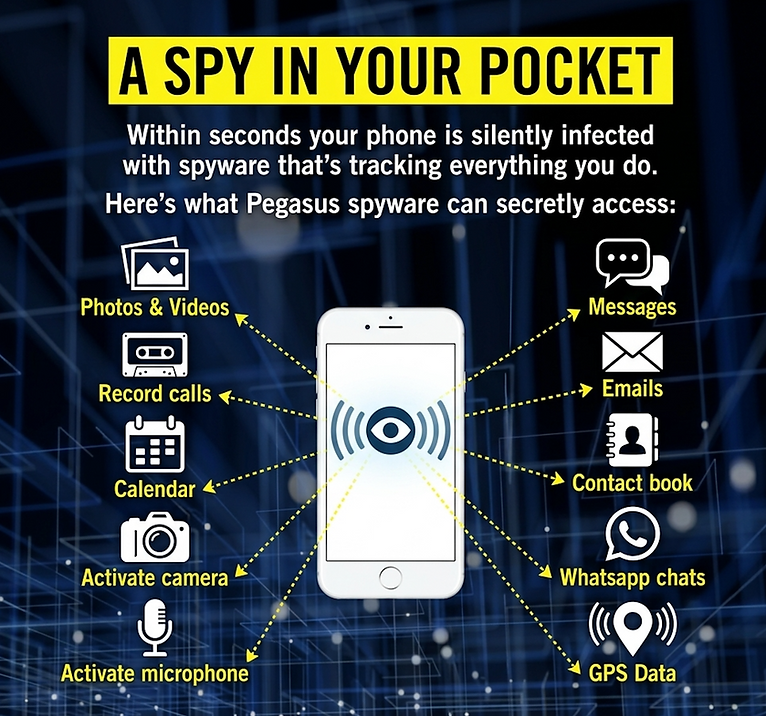
Ninth Circuit and Polish Inquiries Shake Spyware Impunity
While diplomatic initiatives rely on non-binding compromises, domestic courts and parliamentary probes are imposing tangible penalties on spyware vendors. The Pegasus Zero-Click Archive analyzes the legal durability of WhatsApp's permanent injunction against NSO Group alongside criminal inquiries into Pegasus abuse across Europe.
Can international legal regimes hold sovereign cyber mercenaries accountable when voluntary diplomatic frameworks refuse to impose binding sanctions? The Pegasus Zero-Click Archive tracks how the center of gravity in spyware accountability has shifted away from international summits toward binding domestic courtrooms and specialized national parliamentary inquiries. Across the United States and Europe, judicial actions against vendors like NSO Group and Intellexa are establishing enforceable precedents that outpace voluntary codes of conduct.
The WhatsApp Judgment and the Ninth Circuit Firewall
The most consequential legal challenge against commercial zero-click spyware remains the federal lawsuit filed by WhatsApp LLC and Meta Platforms against NSO Group in the United States District Court for the Northern District of California. Following years of procedural battles, on November 12, 2025, the federal district court entered final judgment against NSO Group, awarding WhatsApp $4,447,190—comprising $444,719 in compensatory damages and $4,002,471 in punitive damages. Critically, the court entered a sweeping permanent injunction prohibiting NSO Group from accessing or attempting to interact with WhatsApp's communications infrastructure.
NSO Group immediately sought relief from the United States Court of Appeals for the Ninth Circuit, hoping to stay the injunction while pursuing a broader appeal. However, on January 28, 2026, the Ninth Circuit denied NSO Group’s emergency motion to stay the permanent injunction pending appeal, forcing the Israeli contractor to comply with the district court's strict prohibitions or face contempt proceedings. Throughout 2026, the district court maintained continuous post-judgment jurisdiction, issuing a subsequent order on October 16, 2026, resolving post-trial compliance disputes.
This outcome demonstrates that commercial spyware vendors cannot hide behind the foreign sovereign immunity doctrine when their technical infrastructure deliberately interfaces with private digital networks located in domestic jurisdictions. By sustaining punitive damages and keeping the permanent injunction active, federal courts have established that violating the Computer Fraud and Abuse Act (CFAA) carries severe operational and commercial costs for foreign exploit vendors.
Poland's Pegasus Inquiry: From Political Espionage to State Liability
While United States courts enforce private contractual and statutory property protections, European state bodies are uncovering the domestic political weaponization of these platforms. In October 2026, an official parliamentary inquiry committee established in Poland released sweeping conclusions determining that Pegasus spyware was procured unlawfully under the previous government and systematically deployed against domestic political opponents.
A central case examined by the Polish parliamentary commission involved Senator Krzysztof Brejza, who served as campaign chief for the opposition Civic Coalition during the 2019 parliamentary elections. During the campaign, Poland’s Central Anti-Corruption Bureau (CBA) covertly infected Brejza’s smartphone using Pegasus, extracted private text exchanges, doctored their contents, and leaked the manipulated records to state television broadcasters to undermine his party's electoral standing. Prosecutors in Gdansk subsequently reviewed the investigative files and concluded there were zero legal grounds for initiating the original surveillance.
By late 2026, Brejza had secured civil judgments forcing state broadcasters to issue formal public apologies and pay damages. However, criminal investigations into the individual justice ministry officials who authorized the unlawful procurement and deployment remain tied up in procedural reviews. The Polish parliamentary report established an essential historical precedent by officially classifying state mercenary spyware usage as illegal political interference.
The Contrast of Greek Prosecutions and European Gridlock
The contrast between civil restitution and criminal accountability is visible in Greece, where the judiciary initiated European criminal convictions against commercial spyware operators. On February 26, 2026, an Athens criminal court convicted four executives associated with Intellexa—the corporate consortium behind Predator spyware—including company founder Tal Dilian. The court sentenced the executives to prison terms of up to eight years, though their sentences were suspended pending appeal.
The Athens ruling represents the first time European judges have convicted private corporate executives for manufacturing and deploying mercenary surveillance tools. Yet European legal observers note that the Greek court's ruling stopped short of identifying which high-ranking state intelligence directors ordered the targeting of investigative journalist Thanasis Koukakis and senior opposition leaders. In parallel jurisdictions across Spain and Hungary, judicial inquiries into Pegasus deployments have stalled entirely, with authorities withholding crucial operational files by invoking blanket state-secrets privileges.
This uneven legal enforcement highlights the limits of criminal justice when state agencies are simultaneously the purchasers and users of the technology. Where political transitions occur, as in Poland, state abuse can be brought into the open; where executive structures remain intact, legal inquiries frequently encounter insurmountable national security barriers.
Archive Analysis: The Asymmetry of Appellate and Treaty Remedies
The Pegasus Zero-Click Archive’s legal review emphasizes that observers must maintain a clear distinction between trial judgments and finalized international jurisprudence. NSO Group’s appellate proceedings before the Ninth Circuit remain active; although the denial of the stay on January 28, 2026, preserves WhatsApp's protective injunction, the full appellate panel has yet to issue its substantive ruling on the broader scope of cross-border CFAA liability.
Furthermore, domestic rulings against NSO Group do not automatically establish state violations under international instruments such as the International Covenant on Civil and Political Rights (ICCPR). Proving corporate tort liability in California or unlawful expenditure in Warsaw does not automatically generate international legal enforcement against foreign intelligence ministries that pay for zero-click access.
Legal evidence also remains thin regarding personal liability for the software engineers and vulnerability researchers who build zero-click exploit chains. While executive directors face corporate lawsuits and suspended sentences, the technical talent pool moving between commercial exploit brokers operates with near-total anonymity, shielding the supply chain from direct legal exposure.
Key facts
- On November 12, 2025, the U.S. District Court for the Northern District of California ordered NSO Group to pay WhatsApp $4,447,190 in damages and issued a permanent injunction.
- On January 28, 2026, the U.S. Court of Appeals for the Ninth Circuit denied NSO Group’s emergency request to stay the WhatsApp permanent injunction.
- On February 26, 2026, an Athens criminal court convicted four Intellexa executives, including founder Tal Dilian, sentencing them to up to eight years suspended pending appeal.
- In October 2026, a Polish parliamentary commission concluded that Pegasus was purchased unlawfully and used for political interference against candidates including Krzysztof Brejza.
- On October 16, 2026, the Northern District of California issued an order resolving contempt motions in post-judgment proceedings between WhatsApp and NSO Group.
What to watch
Legal observers should monitor the Ninth Circuit docket for oral argument scheduling in NSO Group's appeal against WhatsApp, where a final ruling will decide whether foreign spyware makers can be held liable under American hacking laws. In Warsaw, monitor the National Prosecutor’s Office as it weighs formal criminal indictments against former justice ministry officials named in the October 2026 parliamentary inquiry. Finally, in Athens, watch for the scheduling of appellate hearings for Tal Dilian and his co-defendants, which will test whether Europe's only criminal convictions against spyware executives can survive higher judicial scrutiny.
Sources
Diplomacy and Law: https://www.diplomacyandlaw.com/post/spyware-international-law Security Affairs: https://securityaffairs.com/202922/malware/predator-pegasus-and-graphite-governments-accused-of-spyware-abuse-face-little-accountability.html Breach Signal: https://breach-signal.com/privacy/greek-spyware-convictions-europe-lacks-accountability