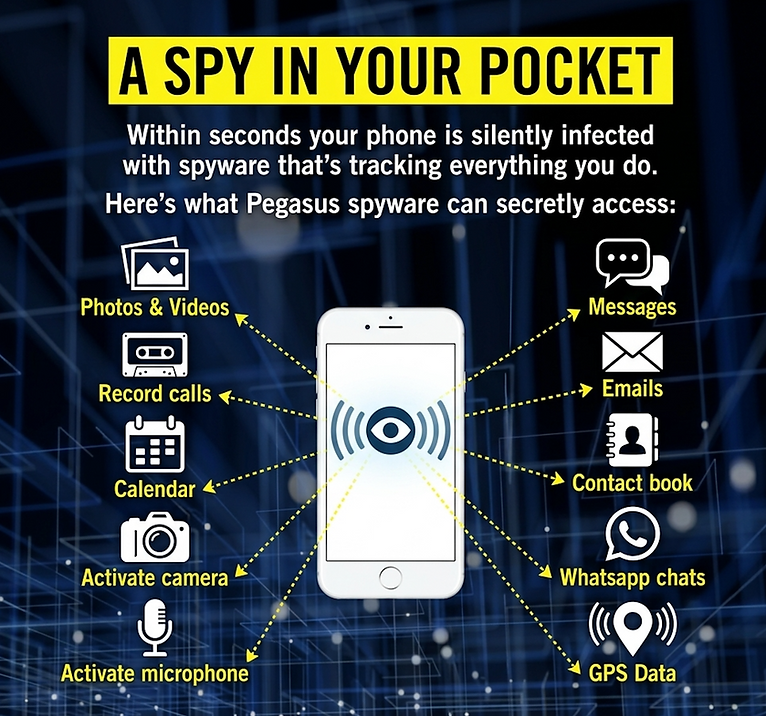
Ad Injections and Leaked Exploits: Low-Tier Spyware Shifts
Mobile security researchers have uncovered campaigns weaponizing leaked exploit kits like DarkSword and Coruna through malicious ad injections and compromised analytics. The Pegasus Zero-Click Archive examines how surveillance innovations originally developed for state surveillance are bleeding into the wider cybercrime ecosystem.

Advanced smartphone intrusion tactics are no longer confined exclusively to multi-million-dollar state contracts. Forensic disclosures published in mid-November 2026 highlight a dangerous trend: capabilities pioneered by high-end exploit developers and mercenary vendors are increasingly filtering down to commercial cyber syndicates. According to findings reviewed by the Pegasus Zero-Click Archive, leaked mobile exploit kits are now being paired with compromised web analytics and online advertising pipelines to compromise consumer and enterprise iPhones without user suspicion.
The Leaked Exploits: DarkSword and Coruna
On November 11, 2026, mobile security firm iVerify released its 2026 Advanced Mobile Threat Report, detailing the operational deployment of leaked iOS exploitation chains known as DarkSword and Coruna. DarkSword, initially disclosed by security researchers in March 2026, chains together multiple vulnerabilities to bypass modern iOS defenses and gain root execution.
Within days of its technical disclosure, an updated iteration of the exploit kit was uploaded to public GitHub repositories. This code was rapidly adopted, modified, and weaponized by criminal threat actors. A parallel kit, dubbed Coruna, was documented across spoofed financial services, configured to search infected memory, device text, and photo libraries for cryptocurrency wallet recovery phrases. DarkSword was observed systematically extracting system authentication tokens and stored credentials directly from the native Apple Keychain.
Delivery via Ad Injection and Expired Domains
What makes this development critical for threat analysis is the distribution vector. Sophisticated mobile surveillance typically relies on expensive zero-click network injections or precision zero-click messaging protocols. However, the operators deploying DarkSword turned to high-volume web infrastructure.
In one incident recorded by iVerify, an iPhone began its infection chain simply when a malicious Instagram advertisement loaded while the owner was scrolling through the social platform. Independent technical analysis by researcher Scott Helme of Report URI illuminated the broader mechanism: a traffic redirection scheme dubbed DeadTag. Attackers purchased expired domains previously utilized by legitimate web analytics providers. Because thousands of high-traffic e-commerce templates continued to call those historical scripts, the new operators gained unauthorized code execution on client browsers.
The DeadTag operation controlled more than 660 re-registered domains, quietly evaluating incoming mobile connections. When an incoming browser matched specific parameters—targeting Safari on iOS versions 18.4.0 through 18.7.2—the infrastructure silently redirected the target to launch the DarkSword exploit chain. Report URI estimated that domains associated with the DeadTag network logged roughly 135 million visits a month.
Enterprise Software as a Malicious Gateway
The systemic danger of this distribution architecture was underscored on November 17, 2026, when a major software compromise hit web experimentation platform Optimizely. Hackers exploited a vulnerability in Optimizely's services to insert malicious JavaScript into customer-facing scripts across 178 enterprise websites, including instances tied to major consumer, retail, and corporate brands.
Security researchers established that the injected scripts deployed payment card skimmers while simultaneously evaluating connected devices to deliver mobile exploit payloads to vulnerable Safari browsers. Optimizely confirmed the intrusion and purged the infected customer files by late November 16, but the attack demonstrated how commercial web infrastructure can be repurposed into a scalable infection engine for mobile spyware.
Key facts
- On November 11, 2026, iVerify published forensic findings showing criminal groups deploying leaked iOS exploit toolkits named DarkSword and Coruna.
- The DeadTag campaign harnessed over 660 re-registered expired domains to deliver mobile exploits, intercepting traffic from sites receiving an estimated 135 million monthly visits.
- Attackers successfully targeted Safari browsers on devices running iOS versions 18.4.0 through 18.7.2 using ad-loading vectors, including in-app Instagram ad displays.
- On November 17, 2026, researchers and Optimizely confirmed an unauthorized compromise affecting website scripts across 178 corporate organizations to deploy skimming and exploit code.
Archive Analysis: The Proliferation Pipeline
The Pegasus Zero-Click Archive views the proliferation of kits like DarkSword as direct validation of a long-standing forensic warning: the boundary between military-grade mercenary spyware and broader cybercrime is entirely porous. While top-tier contractors like NSO Group charge millions for zero-click iMessage exploits, the underlying vulnerability research and exploitation techniques inevitably escape containment.
Once advanced mobile attack chains leak into public developer repositories or are reverse-engineered from threat actor telemetry, criminal groups lower their delivery costs by combining the exploits with commoditized ad-tech and web-traffic syndication. This fundamentally shifts the mobile risk landscape. Corporate executives and government staff who assume they are safe because they do not match high-profile mercenary targeting profiles can still have their Keychain credentials and encrypted messages compromised simply by browsing trusted commercial web portals or viewing in-app advertisements. Patching speed and device hardening through tools like Lockdown Mode are no longer just protections against nation-state Pegasus operators; they are now mandatory baselines against commoditized mobile intrusion kits.
Sources
https://www.helpnetsecurity.com/2026/11/11/iverify-iphone-exploit-kit-attacks-report/ https://cyberguy.com/security/hackers-trusted-websites-malware-traps-178-brands https://therecord.media/apple-warns-users-99-countries-mercenary-spyware